Physical Address
304 North Cardinal St.
Dorchester Center, MA 02124
Physical Address
304 North Cardinal St.
Dorchester Center, MA 02124

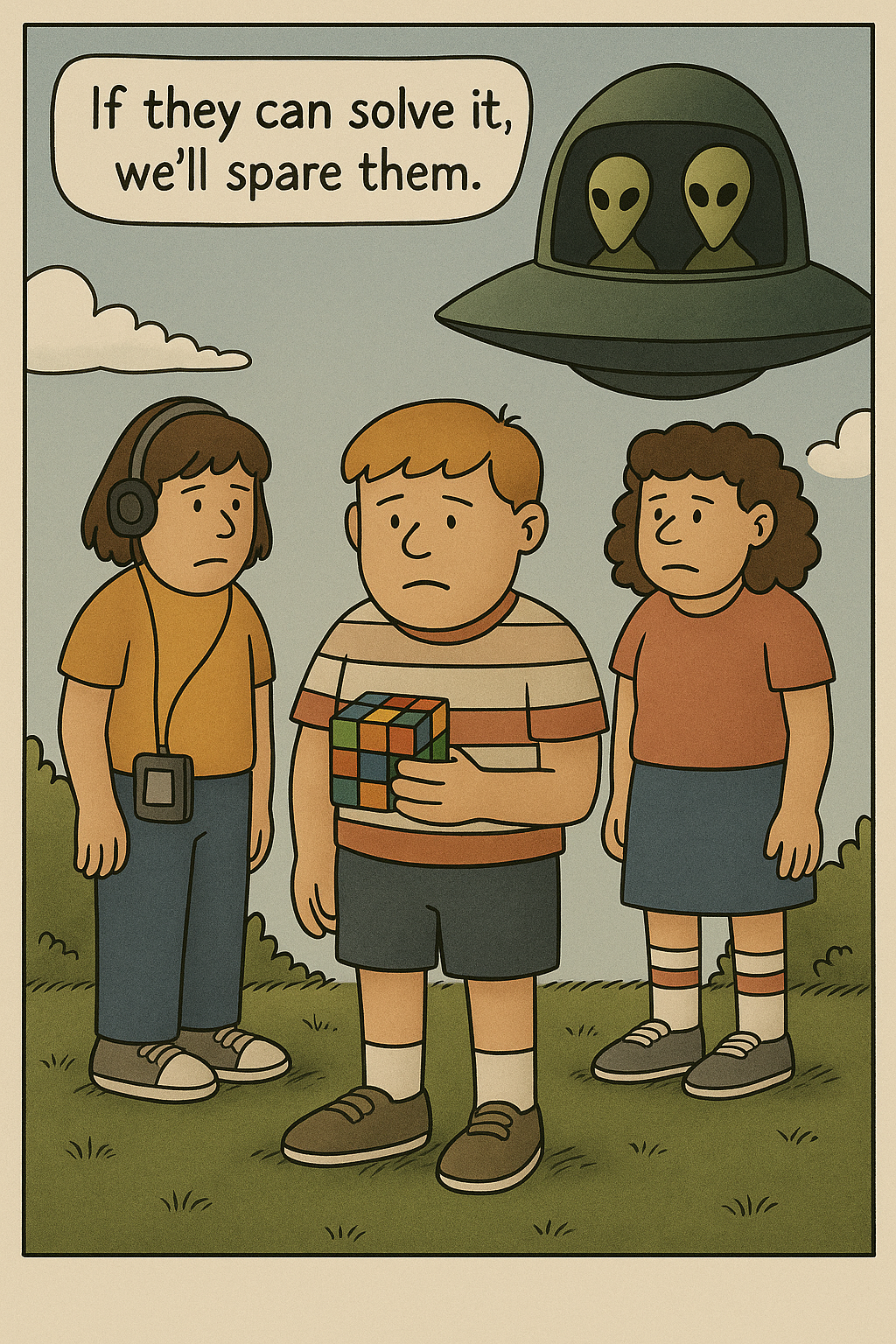
If you grew up in the 1980s, you probably had a Rubik’s Cube… and you probably never solved it.
Not because you lacked intelligence, patience, or hand-eye coordination, but because the deck was stacked spectacularly against you from the start.
Kids today can learn to solve a cube in an afternoon. They have smart cubes, videos, guides, apps, slow-motion breakdowns, animated arrows, color-coded steps, and teaching methods designed by world-class speedcubers.
But 80s kids?
We were tossed into the deep end without a paddle, a lifeguard, or even the ability to swim.
What we had instead was trauma.
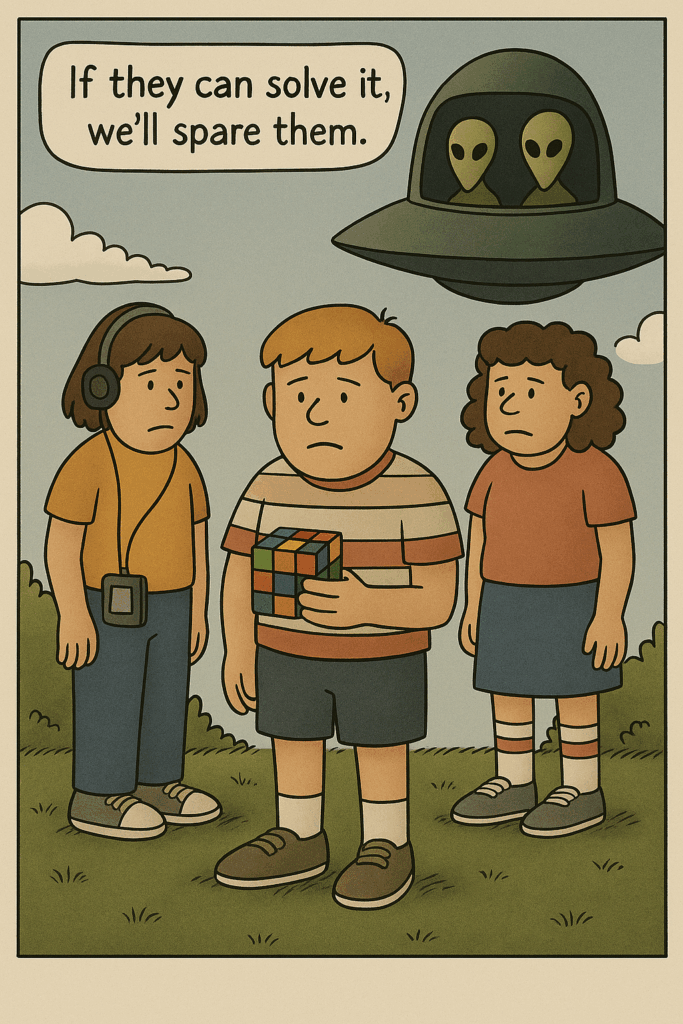
Most cubes in the 1980s came with packaging that proudly announced its existence… and then gave you absolutely nothing else.
No guide.
No walkthrough.
Not even a hint.
It was as if the manufacturers said, “Here’s one of the most mathematically complex puzzles ever created.
Good luck, children.”
There were no YouTube tutorials.
No online forums.
No beginner’s method.
No friendly expert explaining things step-by-step.
If you didn’t have a genius cousin or a bored math teacher willing to help, you were on your own.
There were solution books… theoretically.
Unfortunately, most of them were:
Instead of today’s intuitive “R’ U R U’,” you got explanations like:
“Rotate the rightmost face one quarter turn in the counterclockwise direction when viewed from the right.”
For a ten-year-old, this was basically reading Latin.
And this created a unique psychological cocktail of frustration.
Every classroom, playground, and family gathering had multiple Rubik’s Cubes floating around.
Everyone picked them up, twisted them, and made impressive clicking noises.
But solving it?
Actually solving it?
You almost never saw it happen.
This led to the sinking feeling that everyone else must know something you don’t.
But the truth is…
less than 1% of kids in the 80s actually learned to solve the cube.
The cube wasn’t a puzzle; it was a social pressure device wrapped in bright colors.
Because no one could solve it the honest way, different survival techniques evolved:
The cube became a symbol of ingenuity, but… not the good kind.
For 80s kids, the Rubik’s Cube created a strange kind of quiet trauma:
The cube was a brilliant toy — but also a brilliant frustration machine.
It set an entire generation up for failure and then judged us for it.
Modern kids can learn in minutes what our generation couldn’t crack in months.
They have:
They’re starting a marathon at mile 24.
We were thrown into the woods with a map in Hungarian.
The biggest thing 80s kids need to hear is this:
You weren’t too dumb to solve the cube.
You just weren’t given the tools.
The Rubik’s Cube wasn’t meant to be solved by children in the 80s. Not realistically.
It was a brilliant puzzle released into a world unequipped to help anyone understand it.
And that’s why, for many of us, the cube will always be more than a toy —
it’s a reminder of the decade where ambition outpaced information.