Physical Address
304 North Cardinal St.
Dorchester Center, MA 02124
Physical Address
304 North Cardinal St.
Dorchester Center, MA 02124
When I started doing cubing, I wanted to understand the cube. As a child, more specifically, as a Gen X kid, my experiences with Rubik’s Cubes were similar to pretty much everybody else I talked to from my generation — which is: cool idea, but I couldn’t figure out how to solve more than a little bit of it, got frustrated, and either disassembled it and reassembled it in a solved state, or swapped the stickers. And it didn’t end up being the cool thing that I thought it could be, because I wanted to understand how to manipulate these things. I wanted to understand what it was meant to do in the first place, which is to teach the spatial relationships between the parts and how to make it all work together.
And then, about a year ago, I found a video that showed how to solve it using the beginner method. It was the first time I ever solved a Rubik’s Cube properly. It took me twenty-some-odd minutes following the video, and within a couple of days I was solving it in under five minutes. Soon I got pretty fast at solving it that way. But then, as I wanted to get faster, I realized there were more efficient ways of doing this, even mostly using the same system. I could skip the yellow daisy, go straight to the white cross, and be more efficient with those solves. But then I got to a point where I could only go so fast with that, and the beginner method just requires too many moves. I think I was averaging around 165 moves, so I decided to try to look into the next step of learning. And it was a bit intimidating because there were are 41 move sequences or algorithms for F2L, which I really didn’t want to have to learn. I didn’t want to memorize a bunch of sequences — I wanted to understand the cube.
But then I ran across an intuitive F2L method, and it was confusing, honestly. But it gave me enough information to start to understand how to pair the pieces together and orient them in relation to each other without screwing up the parts of the cube I had already solved. And then I started figuring out my own way of understanding intuitive F2L. And I started teaching some other people my way of explaining it.
It’s funny — when you start to teach other people, or plan on teaching other people, you start to look at things in a different way, and figure out how to explain to people what you’re doing and why. And so I developed my own way of teaching intuitive F2L that required zero algorithms. My approach explained what you do in different situations — more of an “if – then” type of approach.
As I got more efficient with that, I came up with more tricks and efficient approaches, while keeping it simple without too much to remember. And as I taught people, I realized where they were getting caught up and how I needed to improve how I explained things.
Eventually I realized I was developing something pretty different than any of the techniques I had learned. It was definitely based on, and borrowed heavily from other people’s methods, but overall it was explained differently, was in a different order, and avoided memorizing algorithms in favor of understanding what was going on — much more than any of the other methods I had come across.
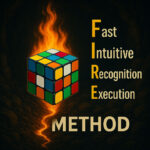
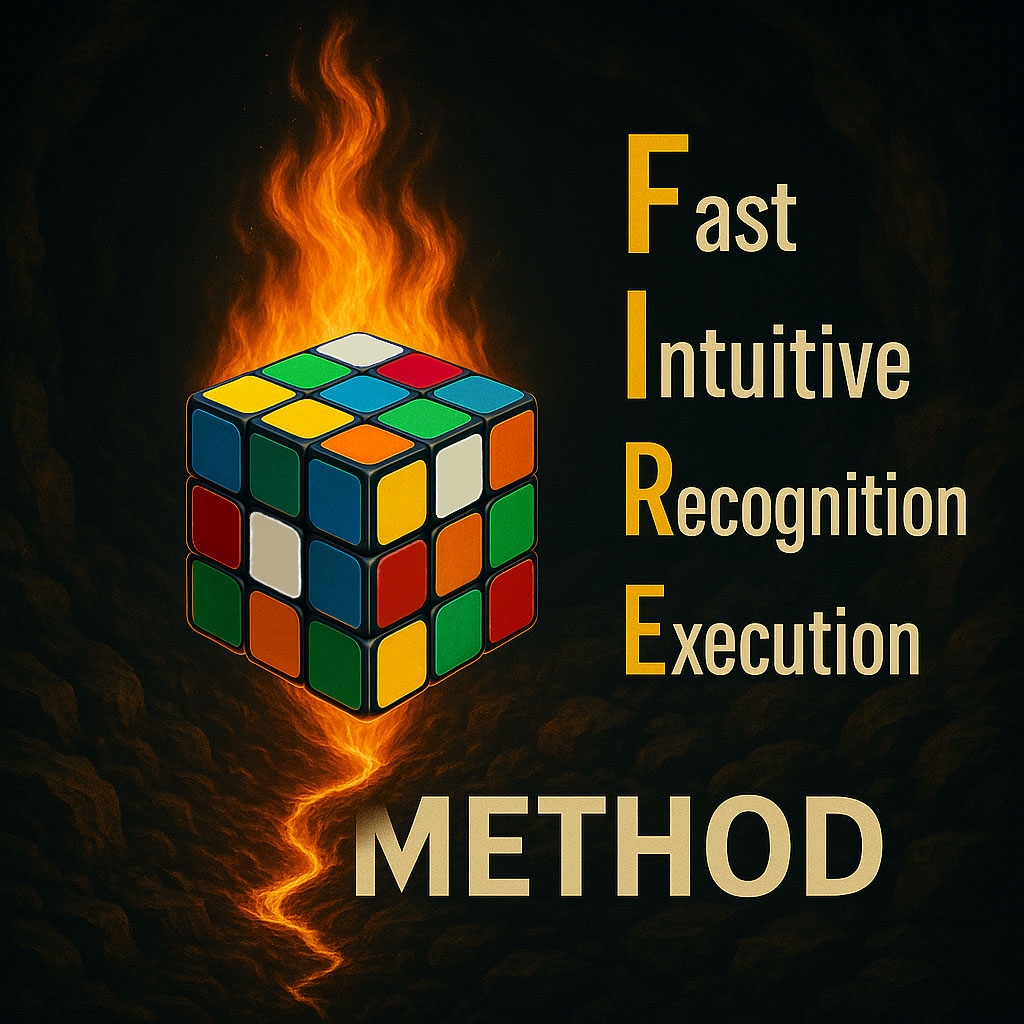
At this point, I realized it was unique enough to be considered a new method — enough different from how other things were taught, that I realized I had something new. So I started developing the FIRE Method, which is how I wish people had taught me.
But then I started thinking about the next step after this. You’re ultimately moving toward even more efficient solves — and ultimately toward CFOP. I hadn’t learned CFOP yet, but that’s what I was moving toward. But in trying to figure out how to do CFOP, I realized I kept on having to unlearn things that I had already learned. And I wondered, what’s the point of this? I know that the next step after you solve the first two layers, in most systems, is to get the yellow top, instead of last like I had learned with other beginner methods. So what would change if I made it so I solved the yellow top first? Then we could start working on the ways of solving the edges and the corners from there, doing it in the actual order that you’d be doing for CFOP.
Once I figured that out, I was like, wait a minute — the two algorithms that I’m using to solve the beginner method you don’t actually use in CFOP. So why would I want to learn and get really fast at these? There have to be CFOP algorithms that do the same things as these algorithms but aren’t that much more complex.
So I started delving deeper and found two that I really liked — UB Perm and AA Perm. And so I figured out ways of teaching those two. And this became the Beginner FIRE Method, which stayed true to the simplicity of the beginner method, but with about fifty fewer moves, faster solves, and better understanding of what is happening and why. And this formed the Beginner FIRE Method I teach.
But through this I realized I should explore faster ways of getting the yellow top, and decided to explore if there was a way to learn two-look OLL using only one algorithm instead of seven or eight. Obviously it wouldn’t be as efficient as learning Sune and Anti-Sune, and their inversions and the others, but how efficient would it be to just use Sune? So I tried every different orientation after solving the yellow cross and observed what happened when you ran Sune with it in each of the four orientations you could run that in. Then I found the most efficient ways to get from there to solved. And it came down to eight if-then options, but that still seemed a little too many to memorize, and I realized I could actually whittle that down to four and not lose any efficiency.
This method shaves an average of twenty-five moves off of the Beginner FIRE Method while only adding one algorithm and four “if-then” options, which became the Standard FIRE Method. It also allows somebody to learn the Basic method, and as soon as they have learned that, they can watch a short video that would build on that and improve speed and reduce moves without a lot of new memorization — so it stays true to the intention of the FIRE Method.
The cool thing about this is it is kind of like a super simplified version of CFOP — however, with only having to learn a handful of algorithms. It is different from other beginner methods in that nothing you learn is wasted or has to be unlearned to move forward. In fact, it is just a very strong and simple basis to build on when moving toward more efficient solving methods. It is my intention to continue to build on this one step at a time, teaching additional steps to remove a few more moves with each new technique you learn so you can get better and better by only having to learn one new thing at a time — not dozens.
I’m still not super fast at some of these, but I’m getting decent solve speeds. At the time of this writing, I think I’m averaging about ninety moves at between forty-five to fifty-five seconds, which will improve as my recognition speed improves and as the speed I can execute the algorithms increases. But they are respectable speeds considering the simplicity of the method.
More importantly, it is attainable for someone who doesn’t want to memorize algorithms and doesn’t care about being a super-fast speed solver. It actually just makes it fun. It keeps the mind sharp and acts as an intelligent fidget toy, passes the time, and impresses the casual observer. For me, I find it calming.